The Most Irresistible Red Velvet Cake That Makes Every Celebration Unforgettable
Most homemade red velvet cake comes out of the oven dense, dry, or a muddy brownish-pink — nothing like the stunning, crimson-layered beauty you had in your head. And almost every time, it traces back to two overlooked steps: cold ingredients going straight into the batter, and overmixing once the flour is added. This recipe addresses both directly, giving you a foolproof method that produces soft, velvety layers and a rich cream cheese frosting every single time.
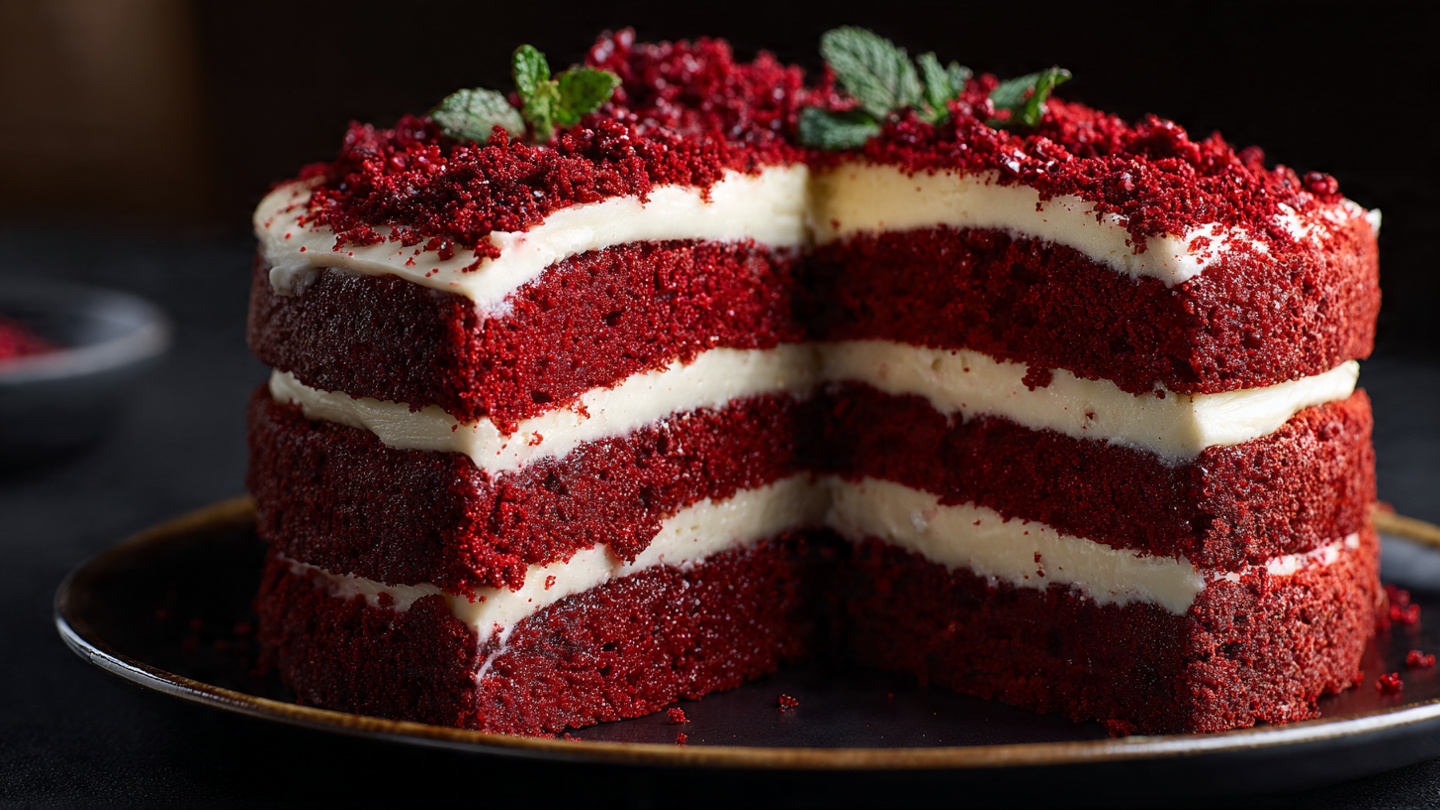
Picture cutting through a slice and watching the fork glide through a crumb so tender it barely resists. The texture is impossibly light yet somehow rich, with a fine, even structure that holds its shape but melts on your tongue. The flavor is understated cocoa — just enough to be interesting — balanced by a subtle tang from the buttermilk that keeps everything from being cloying. And when that silky, cool cream cheese frosting meets the warmth of the cake underneath, it all comes together in a way that’s genuinely hard to describe. You just have to eat it.
This homemade red velvet cake fits anywhere a beautiful dessert belongs — Valentine’s Day dinners, birthday parties, holiday tables, or an ambitious Sunday bake when you want something that looks and tastes like it came from a real bakery. It works as an elegant showpiece for a celebration and travels beautifully to a potluck when you want to be the person who brought that cake. This classic red velvet cake recipe earns a permanent spot in your rotation, and the people who eat it will start asking for it by name.
Why You’ll Love This Recipe
A Texture That Lives Up to Its Name
Red velvet cake is defined by its crumb, and this one fully delivers. The combination of buttermilk, a splash of white vinegar, and the creaming method creates layers so tender and fine they practically melt before you’re done chewing. Every slice holds together beautifully without being gummy or rubbery — just soft, velvety, and satisfying in exactly the way the name promises.
A Flavor That’s Balanced and Unique
This isn’t a chocolate cake wearing a red costume. The cocoa is intentionally restrained, just enough to add depth and complexity without taking over. The buttermilk brings a faint tang that lifts the sweetness, and the cream cheese frosting ties it all together with its own subtle tartness. The result is rich without being heavy — a flavor that’s immediately recognizable and genuinely hard to stop eating.
Approachable Steps for Any Skill Level
Despite how dramatic and impressive this cake looks, the method is genuinely beginner-friendly. The steps follow a standard creaming technique used in most butter cake recipes, the timing is forgiving, and the ingredients are pantry staples. No advanced equipment, no tricky folding — just clear steps and a bit of patience, and you’ll pull out something that looks bakery-quality.
A Show-Stopper for Any Occasion
Few desserts make an entrance like this one. The deep crimson layers against the white frosting create a visual contrast that feels celebratory and a little dramatic — in the best possible way. It works at a birthday party, a Christmas gathering, a Valentine’s dinner, or a potluck where you want to guarantee clean plates. It reliably disappears fast, so make a note to account for that.
Make-Ahead Friendly and Freezer-Ready
The unfrosted cake layers can be baked a full day ahead and stored at room temperature, and they freeze beautifully for up to three months. The cream cheese frosting can be refrigerated up to three days in advance. This means you can spread the work across a couple of days and still present a perfectly fresh, freshly frosted cake whenever you need it.
Ingredients
For the Cake
- 2 ½ cups all-purpose flour
- 2 tbsp unsweetened cocoa powder
- 1 tsp baking soda
- ½ tsp salt
- 1 cup unsalted butter (softened to room temperature)
- 1 ¾ cups granulated sugar
- 3 large eggs (room temperature)
- 1 cup buttermilk (room temperature)
- 1 tbsp white vinegar
- 2 tsp vanilla extract (pure, not imitation)
- 1–2 tbsp red gel food coloring (gel keeps the batter thick and gives a more vivid color than liquid dye)
For the Cream Cheese Frosting
- 8 oz cream cheese (softened to room temperature)
- ½ cup unsalted butter (softened)
- 3–4 cups powdered sugar (sifted, added gradually to reach your preferred sweetness)
- 1 tsp vanilla extract
The butter and buttermilk in the cake create its signature moisture and richness, while the vinegar reacts with the baking soda to produce the delicate, open crumb that defines red velvet. The cream cheese frosting is the finishing touch that makes every element click into place — its tangy creaminess is the perfect contrast to the mildly sweet, tender layers beneath.
How to Make Red Velvet Cake — Step by Step
Step 1: Prepare Your Pans and Your Ingredients
Preheat your oven to 350°F (175°C). Grease two 9-inch round cake pans and line the bottoms with parchment paper circles — this is the step that makes sure your layers come out cleanly without tearing. Pull your butter, eggs, buttermilk, and cream cheese out of the refrigerator now if you haven’t already. Cold ingredients don’t blend properly with each other, which is one of the primary reasons cakes turn out dense rather than light. Give everything at least 30 minutes to come to room temperature before you start mixing.
Step 2: Whisk the Dry Ingredients
In a medium bowl, whisk together the flour, cocoa powder, baking soda, and salt until evenly combined and no streaks remain. Don’t worry if the mixture looks like it has very little cocoa — that’s entirely intentional. Red velvet cake is meant to have a subtle chocolate note rather than a full cocoa flavor, and the balance is precisely what makes it taste the way it does. Set this bowl aside.
Step 3: Cream the Butter and Sugar
In a large bowl, beat the softened butter and granulated sugar together on medium-high speed for about 3 minutes, until the mixture turns pale, fluffy, and noticeably lighter in volume. Add the eggs one at a time, mixing well after each one before adding the next. Stir in the vanilla extract and then the red gel food coloring, mixing until the batter is a uniform, vivid crimson. Don’t worry if it looks intensely red at this stage — the color will deepen and settle beautifully in the oven.
Step 4: Alternate and Combine
With the mixer on low speed, add the dry ingredients and buttermilk to the butter mixture in alternating additions — start with the dry ingredients, then buttermilk, then dry again, finishing with dry. This three-step method keeps the batter smooth and prevents curdling. Mix just until combined after each addition — stop the moment you no longer see streaks of flour. Overmixing at this stage develops too much gluten, and that’s the single most common reason red velvet cake turns out tough instead of tender. Finally, gently fold in the white vinegar. The batter should look smooth, thick, and a glossy crimson.
Step 5: Bake Until a Toothpick Comes Out Clean
Divide the batter evenly between the prepared pans and smooth the tops with an offset spatula. Bake on the center rack for 30 to 35 minutes, or until a toothpick inserted in the center comes out with just a few moist crumbs attached — not wet batter. The edges will pull slightly away from the sides of the pan, and the tops will spring back when lightly pressed. If you’re using a thermometer, the internal temperature should read 200–205°F (93–96°C). Don’t worry if one pan looks like it’s baking slightly faster — oven hot spots are normal, and you can rotate the pans at the halfway mark.
Step 6: Cool Completely Before Frosting
Allow the cakes to cool in their pans for 10 minutes before inverting them onto a wire rack. Let them cool completely — this takes at least an hour, usually closer to 90 minutes — before you add any frosting. Cream cheese frosting applied to a warm cake will melt and slide off, no matter how carefully you spread it. While the cakes cool, beat together the softened cream cheese, butter, vanilla, and sifted powdered sugar until smooth, light, and fluffy. Frost generously between the layers, over the top, and around the sides.
Perfecting This Recipe
- Room-temperature ingredients are the most important variable in this recipe. Butter that’s still cold won’t cream properly, and cold eggs can cause the batter to look curdled and separate. Set everything out at least 30 minutes ahead, or place the eggs in a bowl of warm (not hot) water for 10 minutes to speed things up.
- Use the spoon-and-level method when measuring flour: spoon it into the measuring cup and scrape the top level with a straight edge. Scooping directly from the bag compacts the flour and can add 20–30% more than intended, resulting in a dry, dense cake.
- Add the dry ingredients and buttermilk in three alternating additions, starting and ending with the dry ingredients. This keeps the batter emulsified and prevents a lumpy or separated texture.
- Gel food coloring is strongly preferred over liquid food dye. It gives a more vivid, true red without thinning the batter, and you need far less of it to achieve the same depth of color.
- Cooling completely before frosting is non-negotiable. Rushing this step is the most common reason beautifully baked cakes end up looking like a frosting disaster. Let the wire rack do its job.
- Chill the fully assembled, frosted cake for 30 minutes before slicing. This firms up the frosting and gives you those clean, photogenic layers when you cut.
Common Mistakes to Avoid
- Using cold ingredients straight from the refrigerator — Cold butter won’t emulsify with sugar, and cold eggs can cause the batter to look broken and lumpy. The solution is simple: plan ahead and give everything at least 30 minutes at room temperature before you begin mixing.
- Overmixing after adding the flour — Once flour meets the wet ingredients, gluten develops quickly. Mixing too long after that point is the primary reason red velvet cake turns out chewy and dense rather than soft and tender. Switch to low speed and stop as soon as the batter comes together.
- Using liquid food coloring instead of gel — Liquid dye adds extra moisture to the batter and often produces a brownish or muted result. Gel coloring gives a deeper, more vivid red without altering the batter’s consistency.
- Frosting a warm cake — Even slightly warm layers will cause the cream cheese frosting to lose its structure and slide. Fully cooled means cooled all the way through — feel the bottom of the pan before you frost, and if it’s warm at all, wait.
- Skipping the parchment paper — Greased pans alone aren’t always enough insurance for delicate cake layers. A parchment lining guarantees the layers release cleanly without tearing, which matters especially when you want picture-perfect slices.
Visit Also: Cake Pops
Add Your Touch
- Divide the batter evenly into a lined 12-cup muffin tin and bake for 18 to 22 minutes for red velvet cupcakes — a great option for parties where individual portions make serving easier.
- Pour the batter into a greased 9×13-inch pan and bake at the same temperature for 35 to 40 minutes for a sheet cake version that feeds a crowd without any layering work.
- Stir a teaspoon of espresso powder into the dry ingredients for a subtle depth that amplifies the cocoa without making the cake taste like coffee.
- Replace the cream cheese frosting with ermine frosting — a cooked, butter-and-milk-based frosting — for a silkier, less tangy finish that’s actually the more historically traditional pairing.
- Fold a handful of mini chocolate chips into the batter for little pockets of richness in each slice.
- Layer fresh raspberries or sliced strawberries between the cake tiers under the frosting — the berry tartness plays beautifully against the tangy cream cheese.
What to Serve With This
- A cup of black coffee or a hot latte — the slight bitterness is a natural and satisfying contrast to the sweet, tangy frosting.
- A pot of Earl Grey or chamomile tea for a quieter, afternoon-tea-style pairing.
- A scoop of vanilla bean ice cream beside a warm-from-the-fridge slice for a genuinely indulgent dessert plate.
- A small bowl of fresh raspberries or sliced strawberries to brighten the plate and balance the richness.
- An ice-cold glass of milk, which remains the most classic and universally loved pairing of all.
Storing and Serving
Fridge Store the frosted cake covered tightly with plastic wrap or in an airtight cake container in the refrigerator for up to 5 days. Because of the cream cheese frosting, refrigeration is necessary once the cake is assembled.
Freezer Unfrosted cake layers freeze exceptionally well. Wrap each layer individually in two layers of plastic wrap, place in a zip-lock freezer bag, and freeze for up to 3 months. Thaw overnight in the refrigerator, then bring to room temperature before frosting. Fully frosted slices can also be frozen individually — wrap in plastic wrap, then foil — for up to 2 months.
Reheating This cake is best enjoyed at room temperature rather than reheated. Pull refrigerated slices out 20 to 30 minutes before serving to let the crumb soften and the frosting lose its chill. Microwaving is not recommended, as it can make the frosting greasy and the cake rubbery.
Make-Ahead Tip Bake the cake layers up to one full day in advance, wrap them well, and store at room temperature overnight. The cream cheese frosting can be made up to 3 days ahead and refrigerated — give it a quick re-whip with your mixer to restore its smooth, fluffy texture before spreading.
Servings This recipe yields approximately 12 to 16 slices depending on how you portion it.
Nutrition (Approximate Per Serving)
- Calories: 420–480
- Total Fat: 21–25g
- Saturated Fat: 13–15g
- Carbohydrates: 55–60g
- Sugar: 40–45g
- Protein: 5–6g
- Sodium: 250–300mg
Nutritional values are approximate and may vary based on specific ingredients and brands used.
Chef’s Helpful Tips
- If you forgot to take the butter and eggs out of the refrigerator ahead of time, place the eggs in a bowl of warm water for 10 minutes and microwave the butter in 5-second intervals until just soft — not melted. These quick fixes get you where you need to be without sacrificing results.
- Always sift the powdered sugar before adding it to the frosting. This one step prevents lumps and gives you the smooth, spreadable, bakery-style consistency that makes the frosting look as good as it tastes.
- For picture-perfect slices, refrigerate the fully frosted cake for at least 30 minutes before cutting. Use a sharp chef’s knife dipped in hot water and wiped clean between every cut — this is the trick professional bakers use for those clean, clean layers you see in food photos.
- If your frosting looks too soft and runny, especially in warm weather, refrigerate it for 15 to 20 minutes before spreading. If it firms up too much and becomes hard to work with, add a teaspoon of milk and beat briefly to loosen it.
- Invest in gel food coloring rather than the small liquid bottles from the grocery store baking aisle. The color is dramatically more vivid, you use far less of it, and it won’t affect the texture of your batter.
Frequently Asked Questions
Q1. Can I make this red velvet cake ahead of time? Yes — and it’s actually one of the best things about this recipe. Bake the layers a day in advance, wrap them in plastic wrap, and store at room temperature overnight. Frost the morning of your event and refrigerate until serving. The flavor deepens slightly overnight, which makes the cake even better than it is fresh.
Q2. Can I use oil instead of butter in the cake? Yes, you can substitute an equal amount of vegetable or neutral oil for the butter in the batter. Oil produces a slightly denser but extra-moist crumb and keeps the cake tender for longer after baking. The flavor will be slightly less rich, but the texture is genuinely great — especially useful if you’re making the cake a day or more ahead.
Q3. Is this recipe easy enough for a beginner? Absolutely. The steps follow a standard creaming technique that’s used in most basic butter cakes, so if you’ve made a simple birthday cake before, this will feel familiar. The most important things to remember are: room-temperature ingredients, and stop mixing the moment the flour disappears. Follow those two rules and you’ll be in excellent shape.
Q4. Can I bring this to a potluck? It’s honestly one of the best potluck desserts you can bring, because it travels well and always gets a reaction. Frost the cake at home, refrigerate it until it’s time to go, and transport it in an airtight cake carrier. The cream cheese frosting firms up in the fridge, which actually makes it more stable for transport than a room-temperature frosting would be.
Q5. Can I freeze red velvet cake after it’s frosted? Yes. Freeze individual slices by wrapping each one first in plastic wrap, then in a layer of foil. They’ll keep in the freezer for up to 2 months. Thaw in the refrigerator overnight and let them come to room temperature before eating. The texture holds up well — you’d never know it had been frozen.
Conclusion
There’s a reason red velvet cake has been a fixture on special occasion tables for generations. It manages to be striking and elegant while still feeling warm and familiar — the kind of dessert that makes an event feel more like an event. The dramatic crimson layers, the cool, tangy frosting, the tender crumb that holds its shape but melts when you eat it — it’s a combination that never gets old, no matter how many times you make it.
Once you’ve baked this recipe a few times, it becomes something you can do with confidence and offer to anyone you want to make feel genuinely celebrated. Take it to birthdays, bring it to holidays, make it for no reason at all. Personalize it with the variations that sound right to you, share it with the people who matter most, and enjoy every single compliment that comes your way. This is a recipe worth knowing by heart.
Classic Red Velvet Cake
12-16
servings20
minutes35
minutes420–480
kcal2
hoursTender, vividly crimson cake layers with a light cocoa flavor and velvety crumb, paired with a silky cream cheese frosting — a timeless celebration dessert that’s as beautiful to look at as it is to eat.
Ingredients
For the Cake:
2 ½ cups all-purpose flour
2 tbsp unsweetened cocoa powder
1 tsp baking soda
½ tsp salt
1 cup unsalted butter, softened
1 ¾ cups granulated sugar
3 large eggs, room temperature
1 cup buttermilk, room temperature
1 tbsp white vinegar
2 tsp vanilla extract
1–2 tbsp red gel food coloring
For the Cream Cheese Frosting:
8 oz cream cheese, softened
½ cup unsalted butter, softened
3–4 cups powdered sugar, sifted
1 tsp vanilla extract
Directions
- Preheat oven to 350°F (175°C). Grease and line two 9-inch round pans with parchment paper. Bring all cold ingredients to room temperature.
- Whisk flour, cocoa powder, baking soda, and salt together in a medium bowl. Set aside.
- Beat butter and sugar on medium-high speed for 3 minutes until pale and fluffy. Add eggs one at a time. Mix in vanilla and red gel food coloring.
- Alternate adding the dry ingredients and buttermilk to the butter mixture in three additions each, starting and ending with dry. Mix on low — stop the moment the batter comes together. Fold in the white vinegar.
- Divide batter evenly between the prepared pans. Bake 30–35 minutes, until a toothpick inserted in the center comes out with just a few moist crumbs.
- Cool in pans for 10 minutes, then turn out onto a wire rack. Cool completely before frosting — at least 1 hour.
- Beat cream cheese, butter, vanilla, and sifted powdered sugar until smooth and fluffy. Frost between layers, over the top, and around the sides.