The Most Rewarding Homemade Sourdough Bread Recipe You’ll Ever Bake
The first time I pulled a sourdough loaf from the oven, my entire kitchen smelled like a Parisian boulangerie — that warm, yeasty, faintly tangy perfume that makes you close your eyes and breathe in slowly. I had stayed up past midnight feeding my starter, shaped the dough with flour-dusted hands, and slid the cast iron lid shut with my heart pounding. When the crust crackled as it cooled on the wire rack, I nearly cried. I hadn’t even sliced it yet.
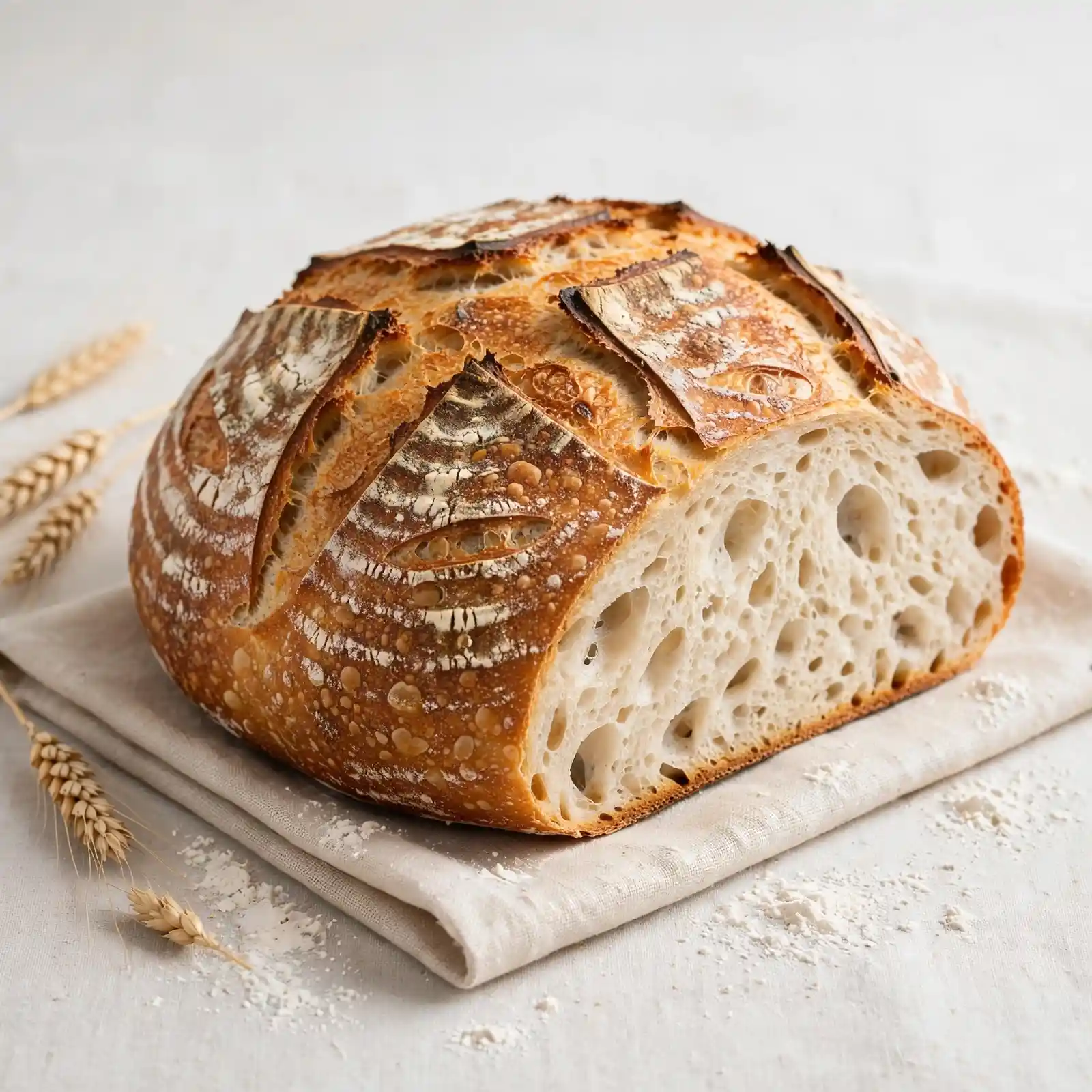
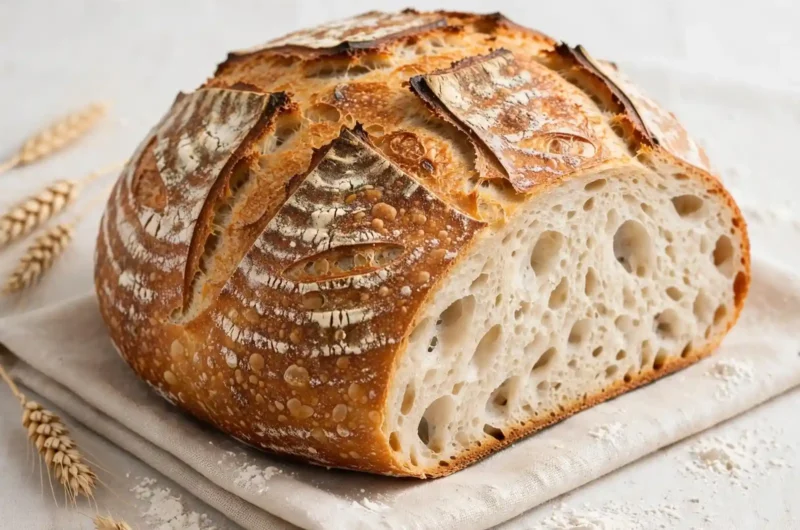
That first cut revealed everything: a golden, blistered crust shattering under the knife and giving way to an open, chewy crumb with that signature sour tang. Each slice had those beautiful irregular holes — proof that fermentation had done its slow, patient work. The inside was soft and slightly moist, the outside nearly brittle. It was nothing like store-bought bread, and that contrast was everything.
This sourdough bread recipe is perfect for slow weekend mornings when you want a project with a delicious payoff. Whether you’re planning a Sunday brunch spread, looking for the perfect base for avocado toast, or stocking up for a week of sandwiches and soups, this homemade sourdough delivers every single time. With its long fermentation and simple ingredients, it’s also a beautiful example of artisan bread at its most honest — no shortcuts, just flour, water, salt, and a living starter doing what they do best.
Why You’ll Love This Recipe
It Has the Perfect Flavor Balance
The natural fermentation process gives this sourdough bread recipe its signature tang without being overwhelmingly sour. The long, cold overnight proof deepens the flavor gently, so every slice tastes complex and satisfying — slightly sour, slightly nutty, and deeply savory. It’s the kind of flavor a grocery store loaf simply can’t replicate.
The Texture Is Absolutely Unbeatable
You’ll get a crumb that’s open, bouncy, and chewy without being gummy, wrapped inside a crust that shatters satisfyingly with every slice. The contrast between the crackling exterior and the soft, airy interior is what makes homemade sourdough so addictive. Once you’ve experienced it fresh from the oven, you’ll never settle for less.
It’s Simpler Than It Looks
Most of the time in this recipe is hands-off — the dough is doing the work while you go about your day. Active prep takes less than 30 minutes total, and the steps are forgiving enough that beginners can succeed with a little patience. The process becomes second nature after just a bake or two.
It’s Made for Sharing
This loaf is the kind of thing you bring to a dinner party and immediately become the most impressive person in the room. It holds up beautifully for potluck spreads, holiday brunches, and lazy weekend gatherings. Slice it thick for a cheese board or thin for open-faced sandwiches — it works beautifully either way.
Classic Bread, Elevated by Fermentation
Unlike commercial yeast breads, this recipe relies on a sourdough starter — a living culture that adds flavor, structure, and digestibility that regular bread simply doesn’t have. It’s ancient bread-making technique with modern clarity, and the results genuinely speak for themselves. You’re making something with history every time you bake it.
Ingredients
For the Starter (Pre-Ferment)
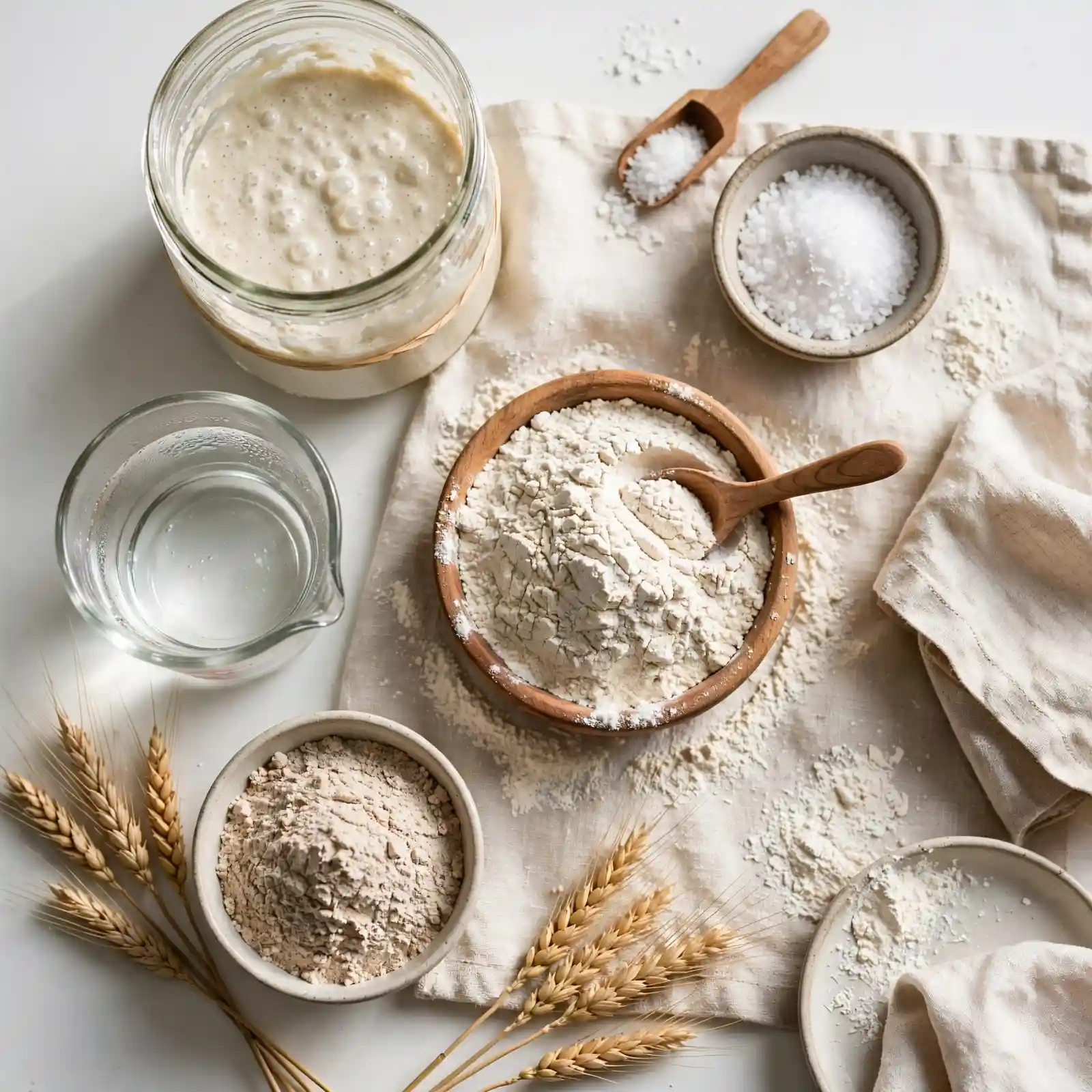
- 50g active sourdough starter (bubbly and doubled, fed 4–8 hours before use)
- 50g bread flour (unbleached, high-protein)
- 50g lukewarm water (around 75°F / 24°C)
For the Dough
- 375g lukewarm water (divided: 350g + 25g reserved)
- 100g active sourdough starter (at peak — bubbly and domed)
- 500g bread flour (unbleached; all-purpose works but gives a denser crumb)
- 10g fine sea salt (not table salt — it distributes more evenly)
For Finishing
- Rice flour for dusting the banneton (prevents sticking better than all-purpose flour)
- A small handful of bread flour for shaping
The starter provides all the lift and flavor here, while the long fermentation allows the gluten to develop fully, creating that chewy, open crumb. Salt tightens the structure and brings out the flour’s natural sweetness — don’t skip it or reduce it.
How to Make Sourdough Bread Recipe — Step-by-Step
Step 1: Feed Your Starter
The night before or 4–8 hours before you plan to mix your dough, feed your sourdough starter with equal parts starter, flour, and water by weight. Stir well, cover loosely, and leave it at room temperature until it’s doubled in size, domed on top, and full of bubbles — it should smell yeasty and slightly tangy. A good test: drop a small spoonful into a glass of water — if it floats, it’s ready to go.
Don’t worry if your starter takes longer than expected on a cold day; temperature plays a huge role in how fast fermentation moves.
Step 2: Mix the Dough
Combine 350g of lukewarm water with 100g of your active starter in a large bowl and whisk them together until fully blended. Add all 500g of bread flour and stir with a stiff spatula or your hands until no dry flour remains — the dough will look shaggy and rough, and that’s completely fine. Cover the bowl and let it rest for 30–45 minutes; this is called autolyse, and it gives the flour time to hydrate and begin developing gluten naturally.
After the rest, dissolve your salt in the reserved 25g of water and pour it over the dough, squeezing and folding it in until fully incorporated. The dough will feel slippery at first but will come together.
Step 3: Stretch and Fold
Over the next 3–4 hours, perform 4 sets of stretch-and-folds, spaced about 30–45 minutes apart. For each set, grab one side of the dough, stretch it up as high as it will go without tearing, and fold it over to the opposite side. Rotate the bowl 90° and repeat until you’ve gone all the way around. After each set, the dough should feel stronger, smoother, and less sticky — you’ll notice the difference between the first and fourth set immediately.
Don’t worry if the dough feels very soft or sticky at the beginning — this is normal for a high-hydration sourdough, and the folds develop all the strength the loaf needs.
Step 4: Bulk Ferment and Shape
Once the dough has grown by about 50–75%, feels airy and jiggly (not dense or tight), and has small bubbles visible on the surface, it’s ready to shape. Turn it gently onto a lightly floured surface and pre-shape it into a round by pulling the edges toward the center and then flipping it seam-side down. Let it rest for 20–30 minutes. Then do a final shape — either a round boule or an oval batard — by stretching and folding the dough tightly before rolling it seam-side up into your rice-floured banneton. The surface should feel taut, like a drum.
Step 5: Cold Proof Overnight
Cover your banneton with a clean shower cap or plastic wrap and refrigerate it for 10–16 hours. This slow, cold fermentation deepens the flavor and makes the dough easier to score. In the morning, your loaf will look only slightly larger — that’s normal. It continues rising in the oven.
Step 6: Bake to a Perfect Crust
About 45 minutes before you’re ready to bake, place your Dutch oven (with the lid on) inside the oven and preheat to 500°F (260°C). When fully preheated, carefully take the Dutch oven out, place a sheet of parchment in the bottom, and flip your cold dough straight from the fridge into it. Score the top decisively with a lame or sharp razor — a single confident slash at a 45° angle works beautifully. Put the lid on and bake for 20 minutes. Then remove the lid, reduce heat to 450°F (230°C), and bake for another 20–25 minutes until the crust is deeply golden-brown and sounds hollow when tapped. Let it cool on a wire rack for at least 1 hour before slicing — the inside is still finishing its cook as it cools.
Perfecting This Recipe
- Use a digital kitchen scale. Volume measurements simply aren’t accurate enough for bread baking — weight is everything.
- Water temperature matters. Cooler water (68–72°F) slows fermentation; warmer water (78–80°F) speeds it up. Adjust to your kitchen’s temperature for consistent results.
- Watch the dough, not the clock. Bulk fermentation times are guidelines, not rules. A warm kitchen can shorten bulk ferment to 3 hours; a cool one might need 5–6.
- Tension is your friend when shaping. A loaf that isn’t shaped tightly enough will spread outward instead of rising upward. The surface should feel like a taut balloon.
- Cold proofing isn’t optional. Skipping the overnight fridge rest makes the dough much harder to score and dramatically reduces the ear (that beautiful raised ridge from the score line).
- Let the loaf rest before cutting. Slicing too early releases the steam still inside, leaving a gummy, undercooked-tasting crumb even if the outside is fully baked.
Common Mistakes to Avoid
- Using a starter that isn’t active — If your starter hasn’t doubled and bubbled after feeding, the dough won’t rise properly. Always do the float test before mixing.
- Rushing bulk fermentation — Cutting the bulk ferment short leaves the dough under-developed, producing a dense, gummy loaf. When in doubt, give it more time rather than less.
- Shaping too loosely — A slack shape gives you a flat, pancake-like loaf instead of the tall, open crumb you’re after. Be deliberate and confident with your shaping.
- Skipping the Dutch oven — The enclosed pot traps steam, which is what creates that iconic blistered crust. Baking on an open sheet pan results in a pale, leathery crust.
- Scoring too shallow — A timid score doesn’t give the loaf room to expand properly. Use a razor lame and cut with one decisive, swift motion at a 45° angle.
Add Your Touch
- Stir in a tablespoon of honey for a slightly sweeter, less tangy crumb — wonderful for toast and butter.
- Fold in roasted garlic cloves and fresh rosemary during the final stretch-and-fold for an irresistible savory loaf.
- Add 1/3 cup of toasted walnuts and 2 tablespoons of dark chocolate chips for a special, dessert-friendly version.
- Use whole wheat flour to replace up to 20% of the bread flour for a nuttier, earthier flavor with more chew.
- Sprinkle seeds — sesame, sunflower, or caraway — onto the shaped loaf before the cold proof for texture and crunch.
- Make a rye-forward version by swapping 100g of bread flour for dark rye flour; the crumb will be denser but the flavor is spectacular.
Visit Also: Sourdough Cinnamon Rolls
What to Serve With This
A thick slice of this crusty bread is practically a meal on its own, but here’s what it loves most:
- Salted butter and flaky sea salt — the most classic, most perfect pairing there is
- A rich bowl of tomato bisque or French onion soup for dipping
- A generous smear of ricotta with honey and crushed walnuts for brunch
- Sharp aged cheddar and whole-grain mustard for an effortless cheese board
- Sliced avocado with chili flakes, lemon juice, and a soft poached egg on top
Storing and Serving
Fridge: Wrap the completely cooled loaf in a beeswax wrap or place it cut-side down on a wooden board. It keeps well at room temperature for up to 3 days, though the crust softens after day one. Avoid refrigerating — it dries the crumb out faster.
Freezer: Slice the loaf before freezing and store slices in a zip-top freezer bag with a piece of parchment between each slice. It freezes beautifully for up to 3 months with virtually no quality loss.
Reheating: For a whole loaf, wrap it in foil and warm in a 350°F (175°C) oven for 10–15 minutes, then uncover for the last 5 minutes to re-crisp the crust. For individual slices, a toaster works perfectly.
Make-Ahead Tip: The shaped dough can be cold-proofed for up to 24 hours — so you can mix on Friday, shape Saturday morning, and bake Saturday night or Sunday morning without any loss in quality.
Servings: One standard boule yields approximately 12–14 thick slices.
Nutrition (Approximate Per Serving)
- Calories: 165
- Total Fat: 0.5g
- Saturated Fat: 0.1g
- Carbohydrates: 33g
- Sugar: 0.5g
- Protein: 5.5g
- Sodium: 290mg
Nutritional values are approximate and may vary based on specific ingredients and brands used.
Chef’s Helpful Tips
- Bring your starter to room temperature at least 4 hours before using it. A cold, sluggish starter won’t provide enough lift and the loaf will be dense.
- If your loaf browns too quickly before the inside is fully baked, tent it loosely with foil for the last 10 minutes of baking.
- To get clean, photo-worthy slices, use a long serrated bread knife and let the blade do the work — don’t press down, just saw gently back and forth.
- High-quality, high-protein bread flour (12–13% protein) gives you a much more open, chewy crumb than all-purpose flour. King Arthur Bread Flour is a consistent favorite.
- If your crumb turns out too dense, the most likely culprits are an under-active starter, under-proofed dough, or too-tight shaping that prevented proper oven spring. Start with the starter — everything flows from there.
Frequently Asked Questions
Q1. Can I use all-purpose flour instead of bread flour? Yes, you absolutely can — the loaf will still taste great, but the crumb will be slightly denser and less chewy since all-purpose flour has a lower protein content. If all-purpose is what you have, go for it; your first sourdough is always a win regardless.
Q2. How does homemade sourdough compare to store-bought? It’s genuinely a different food. Store-bought sourdough often uses vinegar to mimic the tang rather than real fermentation, so it lacks the depth of flavor and the open, chewy crumb of a naturally leavened loaf. Once you taste the real thing, you’ll notice the difference immediately.
Q3. I’m a total beginner — is this recipe manageable? Completely. The steps look long, but most of the time is hands-off resting. The actual work — mixing, folding, shaping, scoring — adds up to maybe 30 minutes total. Start on a weekend when you can be home, follow the steps, and trust the process. You’ll be shocked how intuitive it becomes.
Q4. Can I make this ahead for a dinner party or brunch? This is an ideal make-ahead recipe. Mix and bulk ferment on Friday, shape and refrigerate overnight, then bake fresh on Saturday morning. Your guests will walk in to the smell of fresh bread, and you’ll have done most of the work the night before.
Q5. Can I freeze the baked loaf? Yes — slice it first, freeze the slices in a bag with parchment between them, and pull out what you need as you go. Slices toast straight from frozen beautifully, making this one of the most freezer-friendly breads you can bake at home.
Conclusion
There’s a reason this sourdough bread recipe has become a kind of ritual for so many home bakers — not just a recipe, but a practice. The slow fermentation, the hands-on shaping, the anticipation of that first crack of the crust — it connects you to something ancient and satisfying in a way that very few cooking projects do. And when it works, when you pull that golden loaf from the Dutch oven and the kitchen fills with that irreplaceable smell, it feels like a genuine accomplishment.
Make it once and you’ll want to make it every weekend. Share a loaf with someone and watch their face when they taste it. Bring it to brunch, serve it alongside soup, eat it warm with nothing but butter — however you enjoy it, this is the kind of bread that makes people ask for the recipe. Now you have it. Make it yours.
Crusty Homemade Sourdough Bread
Course: Trending Recipes12–14 slices
servings30
minutes40
minutes165
kcal600-960
minutes180-300
minutes14
hoursA tangy, chewy artisan loaf with a blistered golden crust and an open, airy crumb — made entirely with flour, water, salt, and a living sourdough starter. Perfect for weekend baking, brunch spreads, or gifting to someone you love.
Ingredients
Starter (Pre-Ferment):
50g active sourdough starter
50g bread flour
50g lukewarm water
Dough:
375g lukewarm water (350g + 25g reserved)
100g active sourdough starter (at peak)
500g bread flour (unbleached)
10g fine sea salt
Finishing:
Rice flour (for banneton dusting)
Bread flour (for shaping surface)
Directions
- Feed the starter 4–8 hours ahead. Use when doubled, bubbly, and passing the float test.
- Combine 350g water and 100g starter. Whisk to combine. Add 500g flour and mix until no dry flour remains. Rest 30–45 minutes (autolyse).
- Dissolve salt in remaining 25g water. Squeeze into dough until fully incorporated.
- Perform 4 sets of stretch-and-folds over 3–4 hours, 30–45 minutes apart.
- Bulk ferment until dough is 50–75% larger, airy, and bubbly at the surface (3–5 hours depending on temperature).
- Pre-shape into a round. Rest 20–30 minutes uncovered.
- Final shape tightly. Place seam-side up in a rice-floured banneton.
- Cover and refrigerate 10–16 hours.
- Preheat oven to 500°F (260°C) with Dutch oven inside for 45 minutes.
- Flip cold dough onto parchment. Score with a lame. Bake covered 20 minutes.
- Remove lid, reduce to 450°F (230°C), bake 20–25 minutes until deep golden brown.
- Cool on a wire rack at least 1 hour before slicing.