Perfectly Thin and Easy Crepe Recipe the Whole Family Will Flip For
The first time I made crepes from scratch, I was 19, standing in a tiny kitchen with a borrowed nonstick pan and absolutely no idea what I was doing. But that first silky, lacy-edged crepe rolling off the hot surface felt like pure magic — and I haven’t stopped making them since.
These delicate, paper-thin pancakes carry the most beautiful texture: soft and pliable in the center, with just the faintest golden crispness along the edges. They soak up butter, curl around fillings, and carry the flavors of whatever you tuck inside them — sweet or savory, simple or indulgent — with equal grace.
Whether you’re planning a leisurely weekend brunch, pulling together a last-minute holiday morning spread, or dressing up a weeknight dessert with something a little special, this is the recipe that delivers every single time. Once you discover how straightforward homemade crepes actually are, you’ll wonder why you ever waited so long to try them.

Why You’ll Love This Recipe
Impressively Simple to Make
Don’t let the fancy reputation fool you — this easy crepe recipe comes together with a handful of everyday pantry staples and about five minutes of hands-on prep. The batter rests, you heat the pan, and everything takes care of itself beautifully from there.
A Silky, Delicate Texture Unlike Anything Else
The batter is thin enough to swirl across the pan in one confident motion, and the result is a crepe that is gossamer-soft, almost melt-on-your-tongue, with just enough structure to fold or roll beautifully without tearing.
Endlessly Versatile
Serve them sweet with Nutella and sliced strawberries, or go savory with eggs, cheese, and sautéed mushrooms. The base recipe stays exactly the same — your filling choices are what make each batch entirely your own.
Perfect for Feeding a Crowd
Crepes scale up effortlessly and can be made well ahead of time, making them a dream for family breakfasts, brunch gatherings, or holiday mornings when you want something special without any last-minute stress.
Classic French Flavor with Everyday Ingredients
There’s nothing exotic or hard to find here — milk, eggs, flour, and butter — yet the result tastes like something pulled straight from a Parisian café. That’s the quiet brilliance of a good French crepe batter done right.
Ingredients
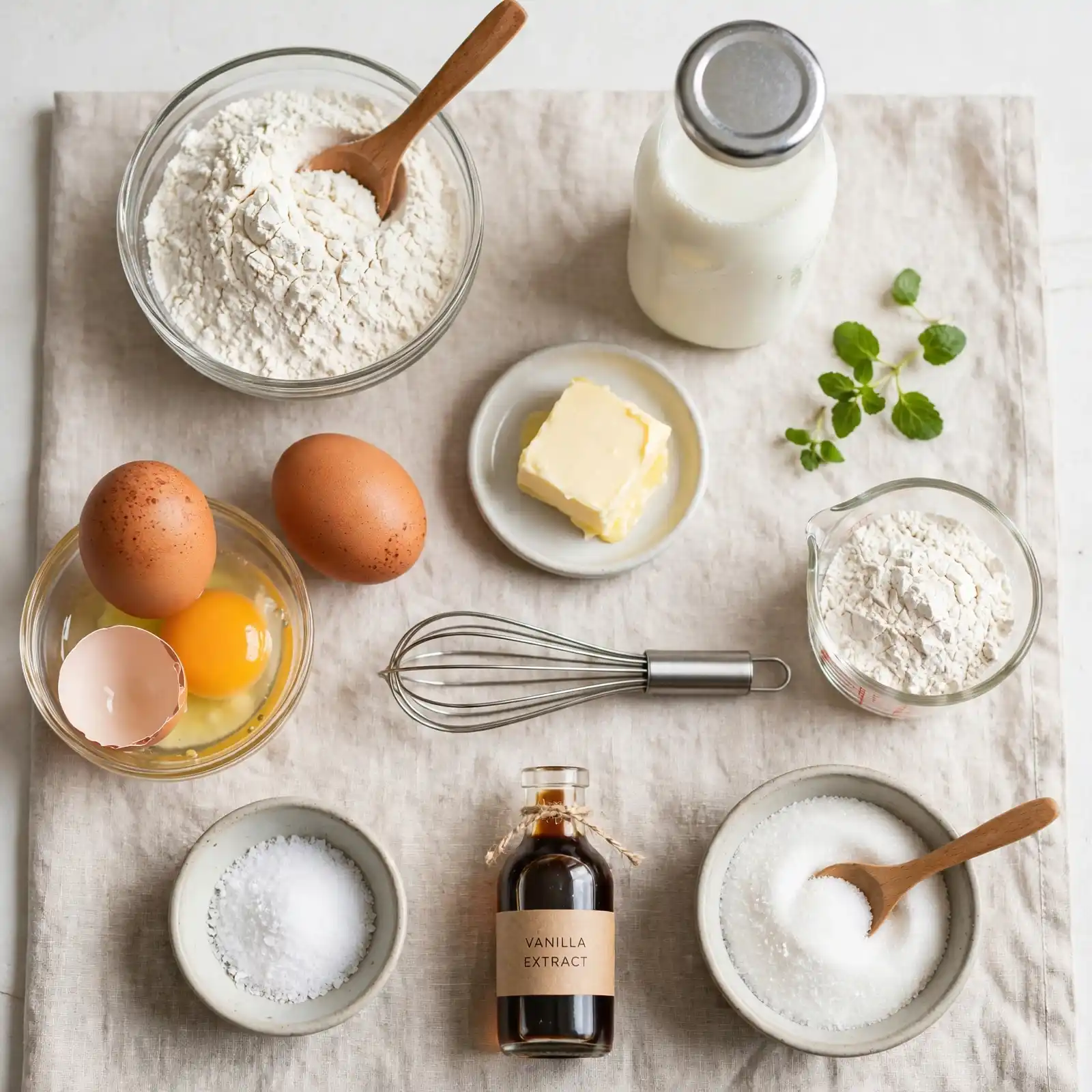
For the Crepe Batter
- 1 cup all-purpose flour (spooned and leveled, not scooped directly)
- 2 large eggs (room temperature)
- 1 ½ cups whole milk (room temperature — see tips)
- 2 tablespoons unsalted butter, melted (plus more for the pan)
- 1 tablespoon granulated sugar (skip entirely for savory crepes)
- 1 teaspoon pure vanilla extract (not imitation)
- ¼ teaspoon fine sea salt
For Serving — Sweet
- Fresh strawberries or sliced bananas
- Nutella, lemon curd, or fruit jam
- Whipped cream or a dusting of powdered sugar
- A drizzle of honey or warm maple syrup
For Serving — Savory
- Shredded Gruyère or sharp white cheddar
- Sautéed mushrooms and wilted spinach
- Soft scrambled or fried eggs
- A spoonful of crème fraîche or sour cream
The flour gives these crepes their structure while the eggs and melted butter create that signature richness and flexibility. The milk keeps the batter fluid enough to swirl thin and even, and the resting time is what brings the whole thing together into something truly special.
How to Make Easy Crepe Recipe — Step-by-Step
Step 1: Make the Batter
Add the flour, eggs, milk, melted butter, sugar, vanilla, and salt to a blender. Blend on medium speed for about 20 to 30 seconds until everything is completely smooth — the batter will look silky, pale, and noticeably thin. Don’t worry if it seems far runnier than pancake batter; that’s exactly how it should look and feel at this stage.
Step 2: Rest the Batter
Pour the batter into a bowl or a pourable pitcher, cover it with plastic wrap, and refrigerate for at least 30 minutes. Overnight works even better. This resting time allows the flour to hydrate fully and the gluten to relax, which means your crepes will spread thinner, cook more evenly, and have that beautifully soft texture you’re aiming for. Don’t worry if the batter thickens slightly in the fridge — a quick stir or a splash of milk will loosen it right back up.
Step 3: Heat the Pan
Place an 8 to 10-inch nonstick skillet or crepe pan over medium heat and let it warm up for a full minute. Add a small knob of butter and swirl it around to coat the surface evenly. The butter should foam gently without turning brown — that’s your signal that the temperature is exactly right.
Step 4: Cook the Crepes
Pour about ¼ cup of batter into the center of the hot pan, then immediately lift the pan off the heat and tilt it in a slow, confident circular motion so the batter spreads into a thin, even round. Set it back on the heat and cook for 60 to 90 seconds, until the edges look dry and pull slightly away from the pan, and the top surface loses its wet sheen. Gently slide a thin spatula underneath and flip — the second side only needs about 30 seconds. Don’t worry if your very first crepe comes out imperfect or oddly shaped; every cook’s first crepe is a test run, and everything after it will be noticeably better.
Step 5: Stack and Fill
Slide each finished crepe onto a plate and stack them as you go — they genuinely will not stick together. Fill them while still warm, or let them cool completely and fill later. For sweet crepe filling, spread Nutella or lemon curd down the center, add your fruit, and fold into quarters or roll into a loose log. For savory, scatter cheese and any warm fillings across the center while the crepe is still in the pan so everything melds together before you fold.
Perfecting This Recipe
- Use a blender for the batter. Thirty seconds in a blender eliminates lumps instantly and gives you a far smoother result than whisking by hand ever could.
- Rest the batter — every single time. Even a minimum 30-minute chill produces noticeably more pliable, evenly cooked crepes. An overnight rest is genuinely worth it.
- Room temperature ingredients are non-negotiable. Cold milk causes melted butter to seize into tiny lumps in the batter. Pull your eggs and milk from the fridge at least 20 minutes before you start.
- Medium heat is your friend. Too high and the batter sets before you can swirl it; too low and the crepe turns rubbery and pale. Adjust between the first and second crepe if needed.
- The first crepe is always a sacrifice. It seasons the pan, helps you calibrate the heat, and teaches you how much batter to pour. Eat it, adjust, and carry on.
- A light butter coating between each crepe matters. Too much butter makes the edges greasy rather than golden. A lightly buttered paper towel dabbed across the pan surface is the cleanest approach.
Common Mistakes to Avoid
- Skipping the resting time — Without resting, the gluten in the flour is tight and tense, causing the batter to resist spreading and resulting in thick, chewy crepes that won’t swirl thin.
- Using cold milk straight from the fridge — Cold milk causes melted butter to clump in the batter, creating an uneven texture that never fully smooths out during cooking.
- Pouring too much batter — A generous pour doesn’t give you a better crepe; it gives you a thick, pancake-like round. About ¼ cup per crepe is the sweet spot for a standard 8-inch pan.
- Flipping too early — Impatience here leads to torn, undercooked crepes. Wait until the edges are completely dry and the center surface looks matte rather than wet before you attempt the flip.
- Cooking on too-high heat — High heat sets the batter almost instantly, leaving no time to swirl and creating hot spots and uneven browning. Trust medium heat and give the pan time to warm up evenly.
Add Your Touch
- Stir 1 tablespoon of cocoa powder into the batter for a rich chocolate crepe base
- Add a pinch of cinnamon or cardamom for a warm, gently spiced note
- Swap half the milk for sparkling water for extra-delicate, almost lacy-edged crepes
- Use buckwheat flour in place of all-purpose for a nutty, earthy savory crepe — traditional in Brittany and absolutely wonderful
- Fold in orange zest or a small splash of Grand Marnier for a classic Crêpes Suzette inspiration
- Layer with mascarpone and crushed raspberries for an elegant dessert crepe stack
- Fill with sliced banana, honey, and toasted walnuts for a simple, deeply satisfying sweet version that needs nothing else
Visit Also: Eggplant Parmesan Recipe
What to Serve With This
- A strong cup of coffee or a proper café au lait alongside sweet crepes for the full French morning experience
- A fresh fruit salad with honey and torn mint — light, bright, and perfect next to richer fillings
- A crisp green salad with a simple vinaigrette to bring balance to a savory crepe lunch or dinner
- Freshly squeezed orange juice or a sparkling lemonade for a brunch table spread that feels genuinely celebratory
- A scoop of good vanilla ice cream with warm, just-made dessert crepes — the temperature contrast is genuinely wonderful
Storing and Serving
Fridge:
Stack completely cooled crepes with small squares of parchment between each one and store in an airtight container or sealed zip-lock bag. They keep beautifully in the refrigerator for up to 3 days without losing their texture.
Freezer:
Layer crepes with parchment paper between each one and freeze in a sealed bag for up to 2 months. They thaw overnight in the fridge and taste just as good as the day you made them — a genuinely great make-ahead strategy.
Reheating:
Warm individual crepes in a lightly buttered pan over low heat for about 30 seconds per side. Alternatively, wrap a small stack in a damp paper towel and microwave for 20 to 30 seconds. They heat through quickly and won’t dry out with either method.
Make-Ahead Tip:
The batter itself can be made the night before and stored covered in the fridge — in fact, an overnight rest gives you the best possible batter. Fully cooked crepes can also be made a full day ahead and kept refrigerated until you’re ready to fill and serve them.
Servings:
This recipe makes approximately 12 to 14 crepes using an 8-inch pan.
Nutrition (Approximate Per Serving — 1 plain crepe, no filling)
- Calories: 85
- Total Fat: 3.5g
- Saturated Fat: 2g
- Carbohydrates: 10g
- Sugar: 2g
- Protein: 3g
- Sodium: 65mg
Nutritional values are approximate and may vary based on specific ingredients and brands used.
Chef’s Helpful Tips
- Room temperature ingredients are more important than they seem. Cold eggs and milk can cause the melted butter to solidify mid-batter, leaving lumps that won’t blend out during cooking. Twenty minutes on the counter is all it takes to fix this.
- A blender will change your crepe life. If you have one, use it. Thirty seconds of blending delivers a lump-free, silky batter that would take five minutes of aggressive hand-whisking to achieve — and even then, never quite as smoothly.
- Don’t hesitate when you swirl. The moment the batter hits the pan, lift it confidently and swirl in one smooth motion. Hesitation lets the batter begin setting before it spreads, and you end up with a thick patch in the center.
- If the batter thickens after resting in the fridge, simply whisk in a tablespoon or two of whole milk until it loosens back to that thin, pourable consistency.
- For clean, crisp edges on every crepe, make sure the pan is properly preheated before the first pour, and resist the urge to move or press the crepe while it’s cooking.
Frequently Asked Questions
Q1. Do I need a special crepe pan to make this recipe?
Not at all. Any good-quality nonstick skillet between 8 and 10 inches does the job just as well as a dedicated crepe pan. The nonstick surface is the important element — the pan shape is secondary. If your nonstick is in good condition, you’re completely set.
Q2. How do I know exactly when to flip the crepe?
Watch the edges closely — when they look dry, slightly golden, and are just starting to pull away from the sides of the pan, and when the center no longer looks wet or shiny, it’s time. That typically happens somewhere between 60 and 90 seconds. Gently nudging a thin spatula under the edge will also tell you immediately if it releases cleanly.
Q3. Can I make this recipe dairy-free?
Yes, easily. Oat milk or almond milk works as a 1:1 substitute for the whole milk, and melted coconut oil or any good dairy-free butter replaces the regular butter seamlessly. The texture will be very slightly different — a touch less rich — but the crepes are still delicious and work beautifully with both sweet and savory fillings.
Q4. Is this recipe beginner-friendly?
Genuinely, yes. The batter takes about five minutes to put together, and the cooking is mostly about building a feel for the swirl and the timing — which comes after the first two or three crepes. Most people find they’ve completely got the hang of it by their third or fourth one. It’s one of those recipes that sounds more intimidating than it actually is.
Q5. Can I freeze crepes once they’re cooked?
Absolutely. Let them cool completely, layer parchment paper between each one, and freeze in a sealed bag for up to two months. Thaw them overnight in the fridge or at room temperature for about 30 minutes before serving. They reheat beautifully and taste just as good as freshly made — which makes this one of the best recipes to batch ahead.
Conclusion
There’s a reason crepes have been a beloved staple in kitchens across the world for generations — they are simple, deeply adaptable, and quietly satisfying every single time. Whether you fold them with fresh berries and cream for a special Sunday morning or fill them with sautéed mushrooms and melted cheese for a cozy weeknight dinner, this easy crepe recipe has a way of making any meal feel a little more intentional, a little more lovely, and a whole lot more worth sitting down for.
So gather your eggs and flour, let your batter rest, and trust the process. The first crepe will teach you, the second will reassure you, and by the third you’ll be swirling with total confidence. Make a generous batch, share them with the people around your table, and don’t be at all surprised when they ask for them again every single weekend after that.

Easy Crepe Recipe
Course: Trending Recipes12–14 crepes
servings5
minutes20
minutes85 per plain crepe
kcal30
minutes55
minutesThin, silky, and golden-edged, these classic crepes are endlessly versatile — equally beautiful filled with strawberries and cream for a sweet breakfast or loaded with eggs and melted cheese for a savory dinner. They come together in minutes and only get better the more you make them.
Ingredients
Crepe Batter:
1 cup all-purpose flour
2 large eggs (room temperature)
1 ½ cups whole milk (room temperature)
2 tablespoons unsalted butter, melted
1 tablespoon granulated sugar (omit for savory)
1 teaspoon pure vanilla extract
¼ teaspoon fine sea salt
For the Pan:
Unsalted butter, for greasing between crepes
Directions
- Blend flour, eggs, milk, melted butter, sugar, vanilla, and salt until completely smooth, about 20–30 seconds.
- Cover and refrigerate batter for at least 30 minutes (overnight is even better).
- Heat an 8–10 inch nonstick skillet over medium heat. Add a small knob of butter and swirl to coat.
- Pour ¼ cup of batter into the pan and immediately tilt in a circular motion to spread into a thin, even round.
- Cook 60–90 seconds until edges are dry. Flip and cook 30 seconds more.
- Slide onto a plate and repeat with remaining batter, lightly buttering the pan each time.
- Fill as desired and serve warm.